Safari Camp Versus Safari Lodge: Which Fits You?
October 10, 2026
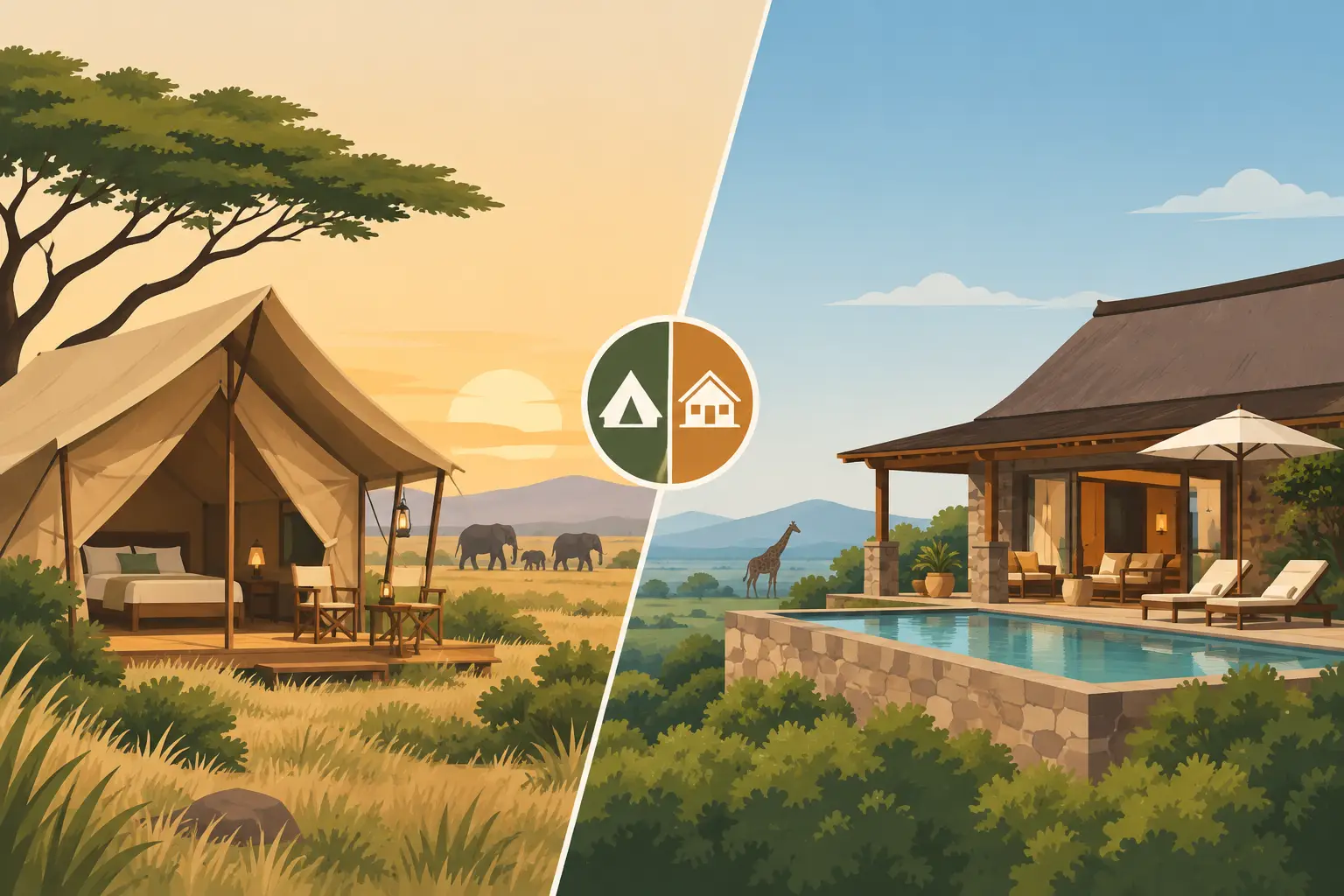
The safari camp versus safari lodge decision is not simply about tented canvas versus solid walls. It shapes the rhythm of your days, how close the wilderness feels after dark, how much privacy you have between game drives, and whether the experience suits your travel party. A remarkable safari can take either form. The right one is the property that supports the way you actually want to travel.
For some guests, that means coffee delivered to a private deck as elephants move through the riverbed below. For others, it means a lively main lodge, a generous family suite, a swimming pool, and the reassurance of more infrastructure after a long morning in the bush. Both can be beautifully designed, deeply comfortable, and expertly guided. The distinction is more nuanced than “camp equals rustic” and “lodge equals luxury.”
Safari Camp vs. Safari Lodge: At a Glance
| Feature | Safari Camp | Safari Lodge |
|---|---|---|
| Atmosphere | Intimate and immersive | Often more resort-like |
| Accommodation | Often luxury tented suites | Usually permanent structures |
| Wildlife sounds | Often more noticeable | Often more insulated |
| Amenities | Vary widely; some have private pools and spas | Often larger pools, spas, gyms, and restaurants |
| Privacy | Often fewer guests | Depends on property size and layout |
| Ideal for | Couples, honeymooners, wildlife enthusiasts | Families, multigenerational groups, comfort-focused travelers |
| Luxury level | Rustic to ultra-luxury | Comfortable to ultra-luxury |
Both camps and lodges can offer exceptional luxury. Location, guiding, and individual property features matter more than the label.
What a Safari Camp Usually Feels Like
A safari camp is typically smaller, more intimate, and designed to place you in close conversation with its setting. Many have canvas-walled suites on raised platforms, proper beds, en-suite bathrooms, thoughtful lighting, and private verandas. At the luxury level, expect details such as soaking tubs, outdoor showers, plunge pools, beautifully prepared meals, and attentive service. Canvas is part of the atmosphere, not a compromise.
The appeal is immersion. You may hear hippos grunting from the water after sunset, birds stirring before dawn, or a lion calling somewhere beyond the lantern-lit pathways. This is one reason camps are especially compelling for honeymooners, wildlife-focused travelers, and couples who want their accommodation to feel like an extension of the landscape rather than a retreat from it.
Smaller camps can also create a more personal social rhythm. With fewer guests, your guide and camp team quickly learn your interests, whether that is photography, birding, tracking big cats, or simply taking your time over a sundowner. In areas where private concessions or conservancies permit flexible activities, the camp itself may be well positioned for night drives, bush walks, or off-road wildlife viewing. Those privileges depend on the reserve and operating rules, not on the word “camp” in the name, so they should always be confirmed property by property.
There are trade-offs. The sensory experience is real: wildlife noises, changing temperatures, and occasional insects are part of sleeping in a wild place. Camp layouts can involve uneven paths or stairs, and some camps are deliberately remote. For travelers who want absolute quiet insulation, elevator access, broad dining choices, or a dependable gym, a lodge may be a more comfortable fit.
What a Safari Lodge Usually Feels Like
A safari lodge generally has a more permanent structure and a broader range of shared spaces. Think substantial suites or villas, a central dining area and bar, expansive decks, and sometimes a spa, fitness room, boutique, wine cellar, or larger pool. The architecture may still be wonderfully connected to the bush, with open-air lounges and vast views, but the experience often feels more resort-like between drives.
Lodges can be an excellent choice for families and multigenerational groups. A larger property may offer family accommodations, more dining flexibility, kid-friendly programming, easier circulation, and enough activity around the main areas that teenagers and grandparents both feel at ease. Travelers celebrating a milestone with several relatives often appreciate having a place where the group can gather comfortably without every moment feeling programmed.
That said, “lodge” does not automatically mean busy. Some of Africa’s most exclusive safari lodges have only a handful of suites and an exceptional sense of seclusion. Likewise, a camp can have generous private villas and an elevated level of service. Guest count, room configuration, location, and guiding model tell you more than the label alone.
A lodge may be particularly attractive at the beginning or end of a longer itinerary, when a little extra space and a longer lunch by the pool feel welcome. It can also be a smart answer for travelers who love wildlife but prefer a more controlled sleeping environment, especially during cooler months or on trips involving young children.
A Real-World Example: Meliá Serengeti Lodge
Meliá Serengeti Lodge in Tanzania illustrates how a safari lodge can combine wildlife experiences with the comforts of a luxury hotel. Overlooking the Serengeti landscape, it offers spacious accommodations, a swimming pool, dining facilities, and opportunities to arrange guided game drives.
For travelers who dream of exploring the Serengeti but prefer permanent accommodations and a comfortable place to relax between excursions, this type of property can be an appealing choice.
It is also a reminder that choosing a lodge does not mean sacrificing the safari experience. The quality of the wildlife encounters depends on the location, season, guides, and activities arranged.
Safari Camp Versus Safari Lodge: The Questions That Matter
Rather than starting with the building style, start with your non-negotiables. The best safari is rarely the most photographed property online. It is the one whose location, guiding, pace, and room setup make the trip feel effortless.
How central is wildlife viewing?
If your main goal is exceptional game viewing, prioritize the ecosystem, season, and guide operation first. A modest-looking camp in the right private conservancy can deliver more compelling wildlife encounters than a grand lodge in a less favorable location at that particular time of year. Migration timing, water levels, vegetation, and animal movements all matter.
For travelers with a specific wish list - perhaps leopard sightings, gorilla trekking, desert-adapted elephants, or the Great Migration - the itinerary should be built around that goal. Accommodation comes next, once the right region and routing are clear.
How private do you want the stay to feel?
A small camp may feel naturally private because fewer guests share the common spaces and vehicles. But privacy is not guaranteed. Ask about the number of suites, vehicles, guests per vehicle, and whether private vehicles can be arranged. For a honeymoon, anniversary, or multigenerational celebration, a private villa or exclusive-use camp can change the entire experience.
A lodge may have more activity around the main areas, which some travelers enjoy. There is a particular pleasure in returning from an afternoon drive, sharing stories by the fire, and feeling part of the gentle energy of the property. The question is whether you want community when you are off safari, or more of a cocoon.
Who is traveling with you?
Families should look beyond whether children are “allowed.” Minimum ages for game drives and bush walks can vary, and long drives are not ideal for every child. A lodge with family suites, a pool, and flexible meal times may be a better choice for younger travelers. Older children and teens who are fascinated by animals may thrive in a small camp with highly engaged guides.
Mobility deserves equally careful attention. Raised decks, sandy trails, stairs, open vehicles, and small aircraft transfers can all affect comfort. There are excellent options for guests with different accessibility needs, but this is a conversation to have early, not an issue to solve after deposits are paid.
What does luxury mean to you?
For one traveler, luxury is a vast suite, climate control, a spa treatment, and a polished wine list. For another, it is waking before sunrise to follow fresh tracks with a guide who has worked the land for decades. Many of the best itineraries offer both: an intimate camp for immersion and a lodge with generous amenities for restoration.
A split stay also prevents comparison fatigue. Instead of trying to find one property that does everything, you can pair distinct environments, such as a water-based safari with a classic savanna experience, or a remote camp with a final lodge stay near an airport. Done well, each stop earns its place.
The Logistics Behind an Easy Safari
The property you love on paper still has to work within the realities of the itinerary. Safari travel often includes light-aircraft flights, luggage limits, road transfers, and early departures. A camp may be more remote, which can be precisely the point, but it may require an additional flight or a longer transfer. A lodge closer to a regional gateway can be easier for a short first safari or a trip combining several countries.
It is also worth looking closely at what happens between drives. Confirm the timing of morning and afternoon activities, the vehicle-sharing policy, dining arrangements, laundry service, room cooling or heating, Wi-Fi expectations, and whether there is a pool. These details sound small until you are several days into the trip.
This is where professional safari planning adds practical value. Lucia can compare the on-the-ground differences that polished websites do not always make obvious: which camps best suit your dates, where a private guide is worthwhile, whether a particular transfer is too ambitious, and how to combine extraordinary properties without turning the journey into a series of rushed check-ins. She also coordinates the moving pieces and remains a human point of contact if plans change.
Choose the place that makes you eager to come back from a game drive and stay awake a little longer. Whether that is a lantern-lit tent listening to the bush or a suite with every comfort close at hand, the right safari accommodation should make the wild feel thrilling, never complicated.
Planning Your First Safari?
Not sure whether a luxury tented camp or a safari lodge is right for you? I'll help you compare locations, wildlife experiences, accommodations, and logistics to design a safari that fits your travel style.